


Gross Profit vs EBITDA: Side-by-Side
| Factor | Gross Profit | EBITDA |
|---|---|---|
| Formula | Revenue - COGS | Revenue - COGS - Operating Expenses + D&A |
| What it measures | Production profitability | Operational profitability |
| Excludes | Operating expenses, taxes, interest | Depreciation, amortization, taxes, interest |
| Use case | Pricing decisions, cost control | Valuation, comparing companies across industries |
| Can EBITDA exceed it? | N/A | No, EBITDA is always less than or equal to gross profit |
| Who uses it | Product managers, operations | Investors, M&A analysts, lenders |
In short:
- Gross profit is the money a company makes after subtracting only the direct costs of producing its goods or services (like materials and labor).
- EBITDA (Earnings Before Interest, Taxes, Depreciation, and Amortization) measures a company’s profitability after operating expenses, but before accounting for interest, taxes, and non-cash items.
- Gross profit focuses on core production efficiency, while EBITDA gives a broader view of operating performance by excluding some non-operational costs.
Assessing the financial health of your business is crucial, but navigating through the range of financial jargon can be a hurdle, like what’s the difference between gross profit vs ebitda?
Terms like gross income, ROI, EBITDA, and operating income get thrown around, leaving you unsure of what actually matters.
That’s why we are going to help you understand two crucial metrics: gross profit vs EBITDA (Earnings Before Interest, Taxes, Depreciation, and Amortization).
Understanding the key differences between gross profit vs EBITDA today.
What is Gross Profit?
Gross profit is the income a company earns after subtracting the costs of making and selling its products or delivering its services. This is also known as sales profit or gross income. You can find gross profit on a company’s income statement.

Gross profit is calculated by taking revenue or sales and subtracting the cost of goods sold (COGS).
It differs from operating profit, which is calculated by subtracting operating expenses from gross profit. Operating profit includes costs like salaries, rent, and utilities that are not directly related to production or sales.
By comparing these two types of profit metrics, you can better understand how efficiently a company is running its core business and managing its expenses.
Recommended Read: All You Need To Know About Gross Profit
How to Calculate Gross Profit?
Gross profit measures how effectively a company uses labor and materials to produce goods or services.
It does not account for fixed costs that remain constant regardless of production levels, such as rent, advertising, and insurance. Instead, it focuses on variable costs that change with output levels, such as:
- Materials
- Direct labor (when it’s hourly or based on output)
- Sales commissions
- Credit card fees
- Equipment usage and related depreciation
- Production site utilities
- Shipping costs
In absorption costing, a portion of fixed costs is allocated to each unit of production. Gross profit is calculated using the following formula:
Gross Profit = Net Sales – Cost of Goods Sold (CoGS)
Want to know more about Gross Profit? Click here
Meaning of each term:
Net Sales
This refers to the total revenue generated from sales during a specific period, minus any discounts and deductions from returned goods. It’s also known as the top line on an income statement because it’s the first line item, from which costs are deducted to calculate net income.
Cost of Goods Sold (CoGS)
This is the direct cost of producing goods or services. It includes the cost of materials, direct labor, and any expenses directly tied to manufacturing or creating the company’s products.
For instance, if a factory manufactures 10,000 products and pays $30,000 in rent for the facility, absorption costing would attribute a $3 cost per product.
Recommended Read: SG&A vs COGS – Difference between Them
What is EBITDA?
EBITDA (or Earnings Before Interest, Taxes, Depreciation, and Amortization) serves as an alternative way to calculate profitability compared to net income.
It excludes certain non-operating expenses to provide a clearer picture of a company’s ability to generate cash from its core business activities.
Here’s a breakdown of what EBITDA removes:
Interest
Financing decisions and capital structure variations can significantly impact interest expenses. Removing them allows for a more standardized comparison between companies.
Taxes
Tax regulations and strategies differ across companies and locations. Excluding taxes facilitates a more focused analysis of operational performance.
Depreciation and Amortization
These are non-cash expenses that account for the gradual wear and tear of assets (depreciation) and intangible assets (amortization). Removing them helps assess a company’s profitability independent of its accounting choices for asset valuation.
EBITDA is not a standard metric under generally accepted accounting principles (GAAP).
However, many public companies include it in their financial reports alongside adjusted EBITDA, which may exclude other costs like stock-based compensation.
Recommended Read: Amortization vs. Depreciation – What’s the Difference?
How to Calculate EBITDA?
There are two main formulas commonly used to calculate EBITDA:
Formula 1 (using Net Income):
EBITDA = Net Income + Interest Expense + Taxes + Depreciation Expense + Amortization Expense
This formula starts with the company’s net income, which represents the profit after all operating expenses are deducted. Then, it adds back the non-operating expenses that EBITDA excludes: interest, taxes, depreciation, and amortization.

Formula 2 (using Operating Income):
EBITDA = Operating Income + Depreciation Expense + Amortization Expense
This formula focuses on operating income, which represents the profit earned from a company’s core business activities before accounting for interest, taxes, and non-cash expenses. Depreciation and amortization are then added back to arrive at EBITDA.
Both formulas achieve the same result: calculating a company’s earnings before interest, taxes, depreciation, and amortization.
The Pros and Cons of Gross Profit
Here’s a look at the benefits and limitations of calculating gross profit.
Benefits of Evaluating Gross Profit
- Emphasizes Product Success: Gross profit focuses on how well a company’s products or services perform, removing overhead costs for targeted analysis.
- Easier to Manage: Gross profit factors are generally more controllable compared to overall operating expenses.
Companies can increase gross profit by reducing production costs or raising product prices.
Constraints of Using Gross Profit
- Incomplete Perspective: Gross profit may not provide a full view of underperformance; low figures could be due to high costs or underpricing.
- Potentially Insufficient Metric: For service sector businesses, gross profit often equals revenue, which can be misleading without considering “below the line” costs when evaluating profitability.
The Pros and Cons of EBITDA
Listed below are the benefits and limitations of calculating EBITDA.
Advantages of Analyzing EBITDA
- Investors: EBITDA offers investors a quick snapshot of a company’s financial health and operational cash generation.
- Analysts: Analysts use EBITDA across various industries to assess companies, especially those without extensive public financials, like large private companies.
- Public Companies: For public companies not operating on a cash basis, EBITDA provides insight into their actual cash flow by considering capital expenditures.

Drawbacks of Analyzing EBITDA
- Non-Operating Expenses: EBITDA excludes expenses like interest, taxes, depreciation, and amortization, possibly overstating cash flow and profits.
- Capital Expenditures: It overlooks capital expenditures such as purchasing equipment or building facilities, which impacts long-term financial health.
- Interest Payments: Ignoring interest payments can give an incomplete view of a company’s overall financial health, as these outflows affect actual earnings and cash flow.
Why Is EBITDA More Important than Gross Profit?
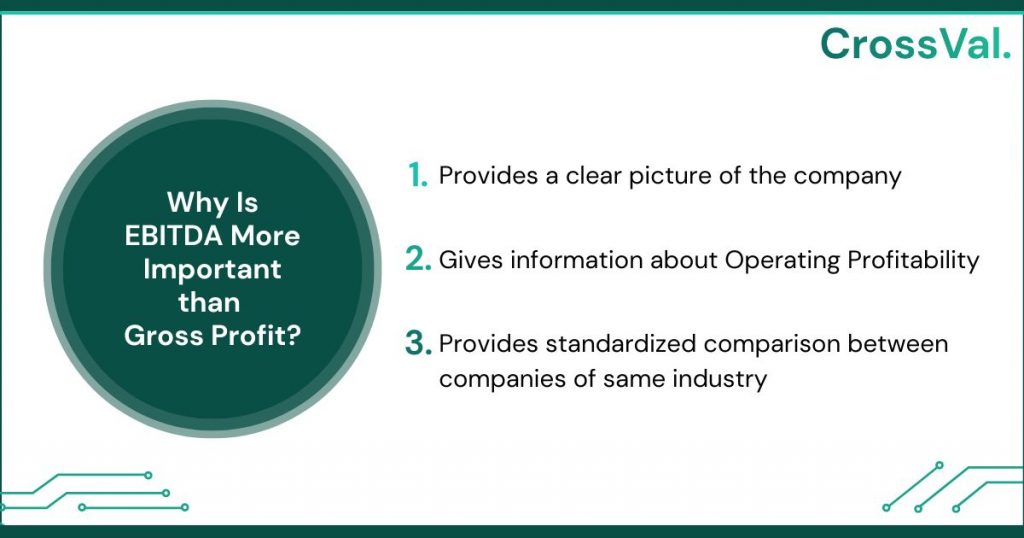
EBITDA is often considered more important than gross profit because it provides a clearer picture of a company’s core operating profitability. By excluding financing and accounting choices like interest, depreciation, and amortization, EBITDA enables standardized comparisons between businesses in the same industry.
Frequently Asked Questions
Can EBITDA be Higher than Gross Profit?
No, when you compare gross profit vs EBITDA, the latter typically cannot be higher than gross profit because of the difference between gross profit and EBITDA:
Gross Profit: This metric represents the profit remaining after subtracting the direct costs of producing goods or services (cost of goods sold) from revenue. It reflects a company’s efficiency in converting raw materials and labor into profit.
EBITDA: Earnings Before Interest, Taxes, Depreciation, and Amortization consider a broader range of expenses. In addition to the cost of goods sold (included in gross profit), EBITDA subtracts operating expenses, depreciation, and amortization.
Since EBITDA subtracts additional expenses beyond those used in calculating gross profit, it will generally be a lower figure.
There could be a rare scenario where comparing gross profit vs EBITDA will be equal to each other, but it’s highly unlikely for it to be higher. This could potentially occur if a company has minimal operating expenses, depreciation, and amortization relative to its cost of goods sold. However, such a situation wouldn’t be typical or indicative of a healthy business.
How do you Convert Gross Profit to EBITDA?
You cannot convert gross profit to EBITDA directly because they measure different aspects of profitability. Gross profit examines efficiency by subtracting the cost of goods sold from revenue. In contrast, EBITDA gives a broader view of operating profitability by adding back interest, taxes, depreciation, and amortization to net income.
How CrossVal Can Help
Now that you understand gross profit vs EBITDA, you can streamline your financial modeling and optimize your financial strategy with CrossVal. Take control of your company’s financial strategy and performance.
CrossVal’s advanced financial modeling capabilities helps you calculate your company’s EBITDA and operating income, figure out where you can make changes, automate tedious tasks, build accurate forecasts, and make data-driven decisions with confidence.
Read more:
Common questions
about this topic.

ajinkya
CrossVal Finance Team
The CrossVal team combines expertise in accounting, tax compliance, and financial technology to help UAE businesses automate their finance operations. Our content is reviewed by chartered accountants and finance professionals with experience in FTA regulations.
LinkedIn